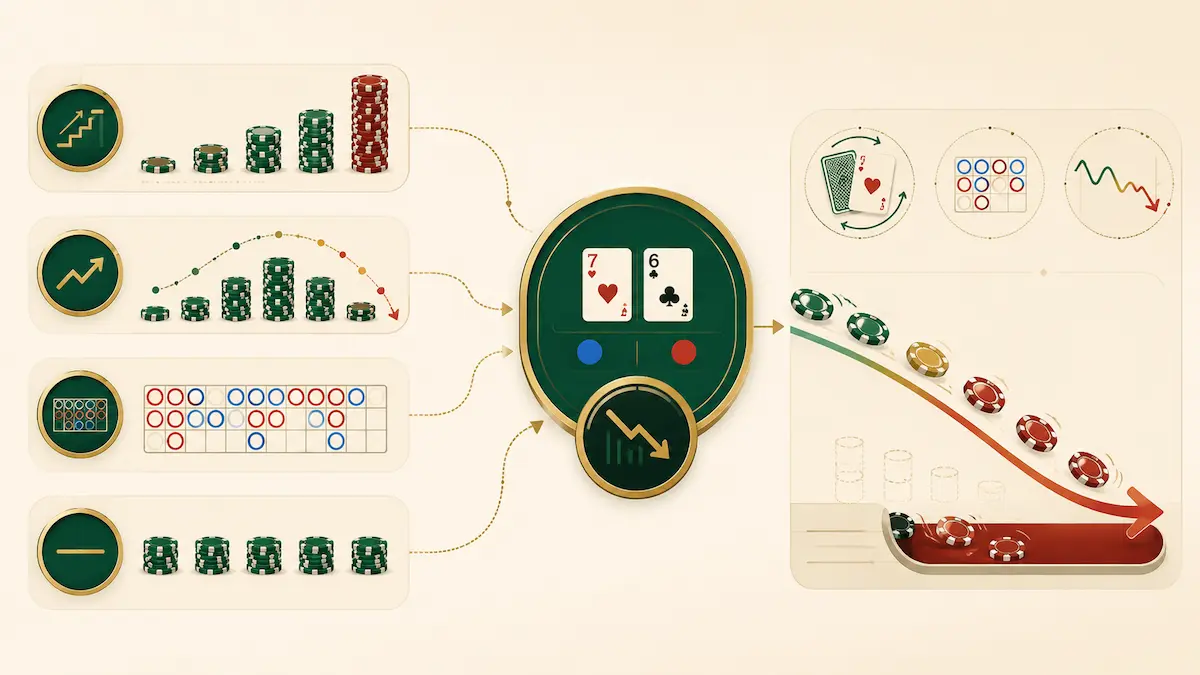


Walk through any casino forum and you will find dozens of baccarat “systems” promising to beat the game. They share one feature: none of them work, and they all fail for the same single reason. Once you understand that reason, you will never be tempted by a betting system again — and you will be able to spot the flaw in any new one within seconds. Here is the proof, in plain language.
The one reason every system fails
It comes down to a single mathematical fact: each hand is independent and carries the same house edge. The cards do not know or care what happened on previous hands. A bet placed after ten losses has exactly the same 1.06% Banker edge as a bet placed after ten wins. Because no past result changes the next hand’s odds, no rule for choosing your next bet — based on past results — can change your expected outcome. Every system is, at root, a rule for choosing your next bet based on past results. That is why they all fail.
The gambler’s fallacy: the engine of false hope
Most systems quietly rely on the gambler’s fallacy — the belief that if something hasn’t happened for a while, it is “due.” After five Banker wins, the Player feels overdue. It is not. Each hand is a fresh, independent event with the same probabilities as the first. Scoreboards and “trend” displays at baccarat tables exist to feed this illusion; they show you patterns in pure randomness and invite you to bet on them. The patterns are real as history and meaningless as prediction. We cover this trap in the context of bet choice on our Banker vs Player page.
Why variance fools everyone
Here is the uncomfortable truth: systems often do win in the short run. That is not evidence they work — it is variance. Over a few dozen hands, almost anything can happen, including a tidy profit. The house edge is a long-run force; it needs volume to assert itself. So a system can “work” for a night, a week, even a month, and still be mathematically guaranteed to lose over enough hands.
| Hands played | What dominates | What you experience |
|---|---|---|
| Tens | Variance | Wins and losses feel random; systems seem to “work” |
| Hundreds | Edge emerging | Results drift toward a net loss |
| Thousands+ | House edge | Loss rate converges on the edge — every time |
The four families of systems — all doomed
| System type | Example | The fatal flaw |
|---|---|---|
| Negative progression | Martingale | Exponential bets hit table limits and bankrupt you on one streak |
| Positive progression | Paroli, 1-3-2-6 | Rides streaks that don’t predict the future; edge unchanged |
| Pattern / trend | “Follow the shoe,” scoreboard betting | Bets on randomness; the gambler’s fallacy in action |
| Flat staking | Same bet every hand | Honest and lowest-risk — but still loses at the house-edge rate |
Notice the last row: even flat betting, the most rational approach, cannot win. It is simply the least harmful way to lose, which is exactly why we recommend it alongside good bankroll management.
Why this is actually good news
If no system can win, you are freed from chasing one. You can stop buying e-books, stop tracking scoreboards, and stop risking ruin with progressions. The optimal approach is refreshingly simple: bet the Banker, avoid the Tie, size your bets to your budget, and quit at a pre-set point. That’s it. Everything beyond that is marketing.
Where to go next
See the most famous system dissected in our Martingale guide, build a plan that actually protects your money with bankroll management, or return to the honest strategy overview.
Why do all baccarat betting systems fail?
Because each hand is independent and carries the same house edge. No rule for sizing or sequencing bets based on past results can change the odds of the next hand, so the sum of negative-expectation bets stays negative.
What is the gambler’s fallacy?
The mistaken belief that a result is “due” because it hasn’t happened recently — for example, expecting the Player after several Banker wins. Each hand is independent, so nothing is ever due.
If a system won for me, doesn’t that prove it works?
No. Short-term wins are variance, not evidence of an edge. The house edge only asserts itself over thousands of hands, by which point every system loses at the edge rate.
Is flat betting a winning system?
No, but it is the least risky way to play. Flat betting still loses at the house-edge rate; it simply avoids the catastrophic swings of progression systems.
Can tracking the scoreboard or trends help me win?
No. Scoreboards show past results, which do not predict future hands. Betting on trends is the gambler’s fallacy and offers no edge whatsoever.