

Baccarat has a reputation for mystery, but the rules fit on a single card. There are exactly two drawing rules — one for the Player hand, one for the Banker hand — and once you have seen them laid out, the so-called “third-card rule” stops being intimidating. This page gives you the complete, accurate drawing chart used in casinos worldwide, plus plain-English explanations of every line.
The order of play
Player's rule
| Initial total | Action |
|---|---|
| 0–5 | Draw |
| 6–7 | Stand |
| 8–9 | Both stand (Natural) |
Banker's rule
When Player did draw, Banker's decision depends on Player's third card.
| Banker initial | Action |
|---|---|
| 0–2 | Always draws |
| 3 | Draws unless P3 = 8 |
| 4 | Draws when P3 = 2–7 |
| 5 | Draws when P3 = 4–7 |
| 6 | Draws when P3 = 6 or 7 |
| 7 | Stands |
If Player stood (initial 6 or 7), Banker draws on 0–5 and stands on 6–7.
Every round resolves in the same fixed sequence. We walk through a live example in how a baccarat round works, but here is the rule order in brief:
- 1The deal.Two cards are dealt to each hand.
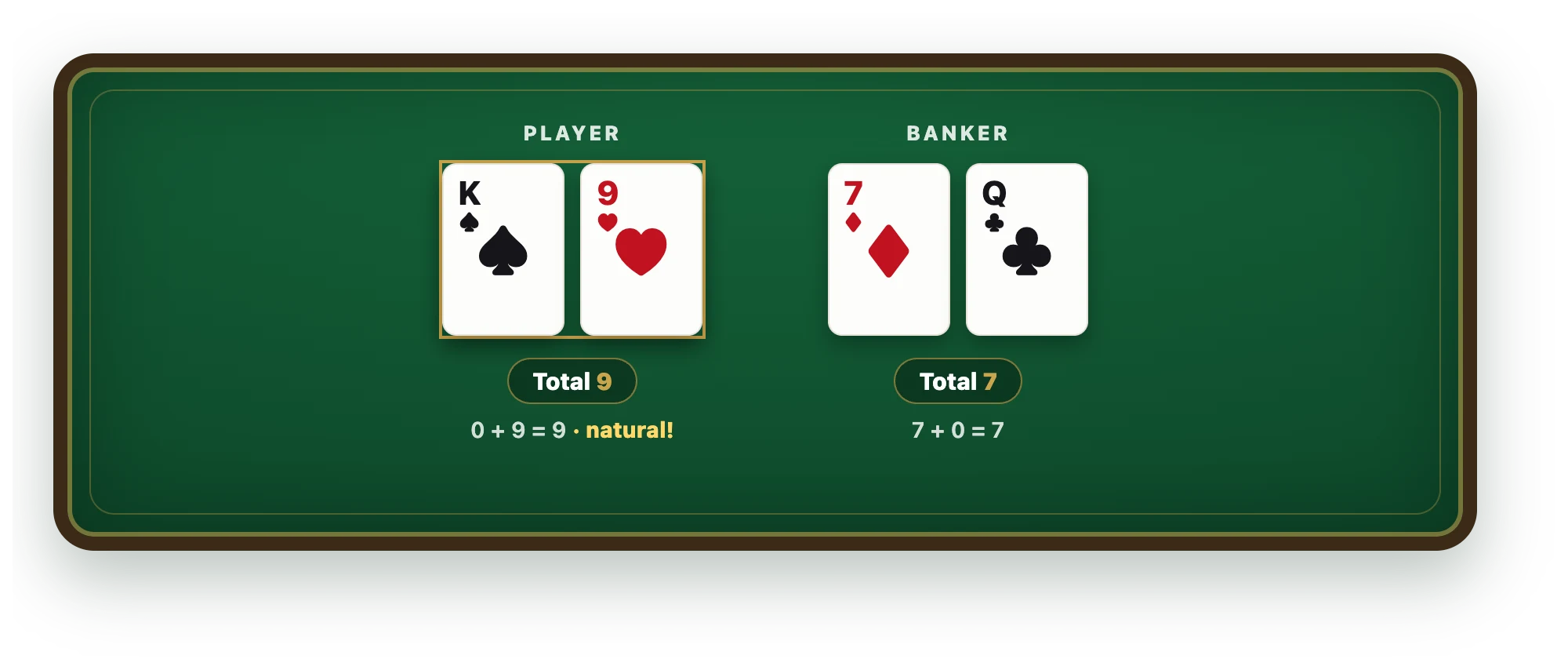
- 2Check for a natural.If either hand totals 8 or 9, both stand and the round ends.
- 3The Player rule.Decides whether the Player draws a third card.
- 4The Banker rule.May depend on the value of the Player’s third card.
- 5Compare totals.The hand closest to 9 wins.
The Player drawing rule
The Player hand is resolved first and follows one line:
| Player’s first two cards total | Player’s action |
|---|---|
| 0, 1, 2, 3, 4, 5 | Draws a third card |
| 6 or 7 | Stands |
| 8 or 9 | Natural — round ends, no draw |
The Banker drawing rule
If the Player stood (on 6 or 7), the Banker plays by the same simple logic: draw on 0–5, stand on 6–7.
The complexity appears only when the Player drew a third card. Then the Banker’s decision depends on two things: the Banker’s own total, and the point value of the card the Player just drew. The Banker hand is built to react to that card, which is the structural reason it wins slightly more often than the Player hand — the full statistical breakdown is on our Banker vs Player page.
The complete Banker third-card chart
When the Player has drawn a third card, the Banker acts as follows:
| Banker’s total | Banker draws if Player’s third card is… | Banker stands if Player’s third card is… |
|---|---|---|
| 0, 1, 2 | Always draws | — |
| 3 | 0, 1, 2, 3, 4, 5, 6, 7, 9 | 8 |
| 4 | 2, 3, 4, 5, 6, 7 | 0, 1, 8, 9 |
| 5 | 4, 5, 6, 7 | 0, 1, 2, 3, 8, 9 |
| 6 | 6, 7 | 0, 1, 2, 3, 4, 5, 8, 9 |
| 7 | Always stands | Always stands |
This single table is the entire “secret” of baccarat. Notice the pattern: the higher the Banker’s total, the narrower the range of Player third cards that prompt it to draw — a higher hand has less to gain and more to lose by taking another card.
Naturals override everything
It is worth repeating because it is the rule newcomers forget: if either hand holds a two-card 8 or 9, the drawing rules above never come into play. A natural 9 beats a natural 8; matching naturals tie. The drawing chart only matters when neither hand starts with a natural. For how those two cards are added into a total in the first place, see how baccarat hands are scored.
Punto banco, chemin de fer, and banque
The rules on this page describe punto banco, the version played in virtually every casino and online game today. In punto banco the house banks every hand and all draws are automatic. Two older variants — chemin de fer and baccarat banque — let players take the bank and make some drawing choices, but you will rarely encounter them outside high-limit European rooms. Unless a table explicitly says otherwise, the chart above is the one in force.
Where to go next
With the rules clear, see them in motion in a full round walkthrough, or step back to the how-to-play overview. To understand why these rules produce the edges they do, head to odds and probabilities and our house edge breakdown.
Do I have to learn the third-card rules to play baccarat?
No. The dealer or software applies every drawing rule automatically. You only need the chart if you want to understand why the Banker bet has a lower house edge.
Why is the Banker rule more complicated than the Player rule?
Because the Banker acts last and is allowed to react to the Player’s third card. That extra information is exactly what gives the Banker hand its small statistical advantage.
Can a hand ever get a fourth card?
No. Each hand receives a maximum of three cards — the original two plus, at most, one draw.
Are the rules the same at every casino?
For punto banco — the standard game online and in casinos — yes, the drawing chart is universal. Only the commission rate and Tie payout occasionally differ.
What is the difference between punto banco and chemin de fer?
In punto banco the house banks every hand and all draws are automatic. In chemin de fer players can bank the hand and make limited drawing decisions. Punto banco is by far the more common form.