

Scoring a baccarat hand takes one rule: add the cards together and drop the tens digit. A hand can total anywhere from 0 to 9, it can never “bust,” and there is no total higher than 9. That is genuinely all there is to it — but the few quirks (why a King is worth nothing, why 7 + 8 makes 5) trip up newcomers, so this page settles every one with clear examples.
Card point values
- Tens and face cards = 0
- Ace = 1
- Drop the tens digit
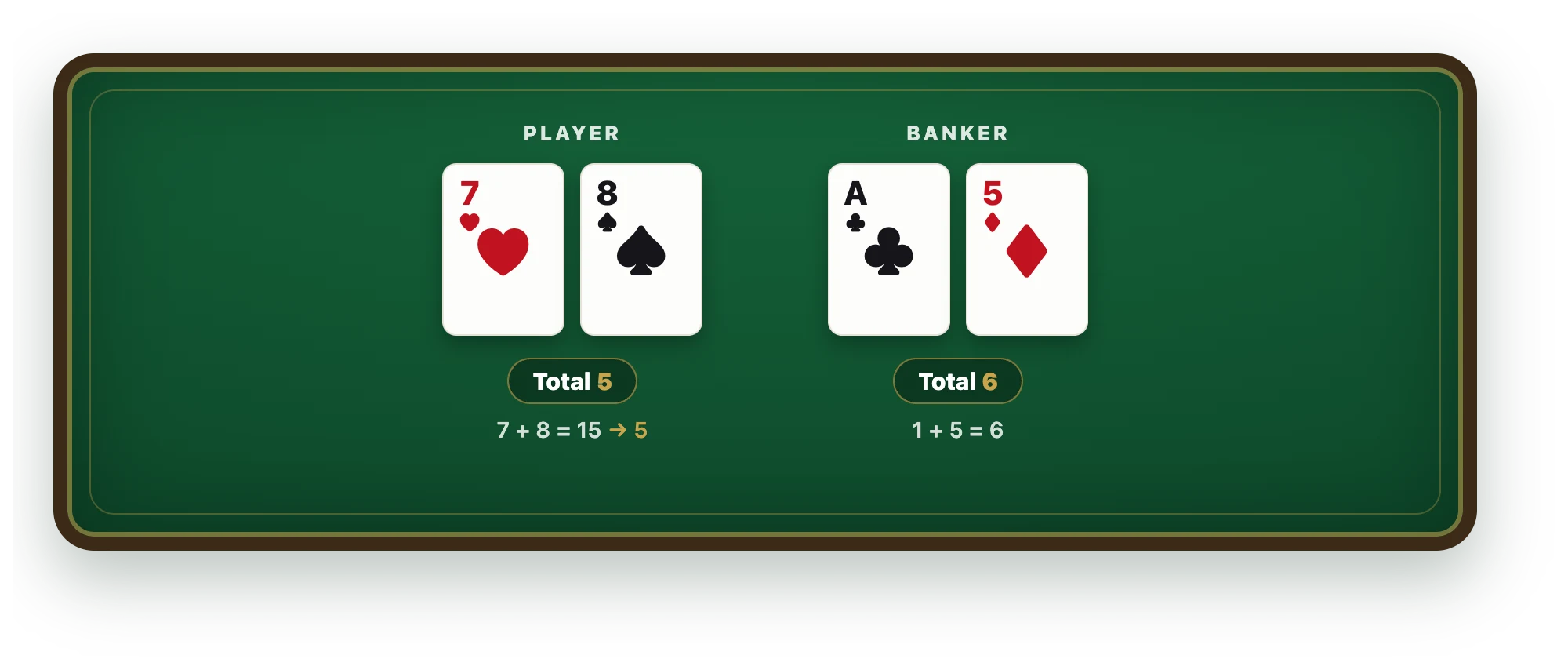
Example 1
Total: 15 → Score: 5
7 + 8 = 15 → drop the 1 → score 5
Example 2
Total: 7 → Score: 7
K counts as 0, plus 7 = 7. No drop needed.
Example 3
Total: 18 → Score: 8
9 + 9 = 18 → drop the 1 → score 8 (strong start)
Suits never matter in baccarat — only the rank’s point value does. The table is short and worth memorising:
| Card | Point value |
|---|---|
| Ace | 1 |
| 2, 3, 4, 5, 6, 7, 8, 9 | Face value (2 through 9) |
| 10, Jack, Queen, King | 0 |
Four of the thirteen ranks — the 10 and the three face cards — are worth zero. That is why low totals are so common and why a strong starting hand is genuinely valuable. This same point scale drives the drawing rules that decide whether a third card appears.
The one scoring rule: drop the tens digit
Add your cards together. If the total reaches 10 or more, you ignore the tens digit and keep only the units. Mathematically, the score is the sum modulo 10 — but you never need that word at the table. Just read the last digit.
Worked examples
| Cards | Raw sum | Baccarat score |
|---|---|---|
| 7 + 8 | 15 | 5 |
| 9 + 6 | 15 | 5 |
| King + 9 | 9 | 9 (a natural) |
| 10 + Jack | 0 | 0 (“baccarat”) |
| Ace + 5 | 6 | 6 |
| 4 + 4 + 5 | 13 | 3 |
Notice the last row: even with a third card, the rule is unchanged — add all the cards and keep the last digit.
Naturals: 8 and 9
A two-card total of 8 or 9 is called a natural, and it is the highest you can start with. A natural ends the round instantly: no third card is drawn for either hand. A natural 9 is the strongest hand in the game and beats a natural 8; two equal naturals tie. Because tens and faces are worth nothing, naturals are special events — you cannot build one from high cards, only from the right mid-range combination.
Why no hand ever busts
In blackjack, going over 21 loses instantly. Baccarat has no such trap, because the tens digit is always discarded — the score simply wraps around. The lowest score, 0, even has a name: “baccarat,” the Italian and French word for zero, which is how the whole game got its title. This wrap-around is also why card values behave so differently from blackjack, a contrast we touch on throughout the how-to-play guide.
From scoring to strategy
Understanding scoring is the foundation for everything that follows. Once you can read a total at a glance, the third-card rules make sense, the house edge figures become meaningful, and you can judge for yourself why the Tie bet — despite its tempting payout — is a poor wager. The maths is laid out in full in our odds and probabilities section.
Where to go next
Now that totals make sense, learn the drawing rules, watch a full round play out, or return to the how-to-play overview.
How do you score a baccarat hand?
Add the point values of the cards and keep only the last digit. Aces are 1, 2 through 9 are face value, and 10s and face cards are 0. A total of 15 scores 5.
Why is a King worth zero in baccarat?
All tens and face cards (10, Jack, Queen, King) are valued at zero. Only aces through nines carry points, which keeps every total between 0 and 9.
Can a baccarat hand go bust?
No. Because the tens digit is always dropped, totals wrap around to a single digit, so no hand can exceed 9 or bust.
What is the highest hand in baccarat?
A natural 9 — a two-card total of nine. It is unbeatable except by a tie with another natural 9.
What does “baccarat” mean?
It means “zero” in Italian and French, the value of the worst possible hand. The game is named after its lowest score.