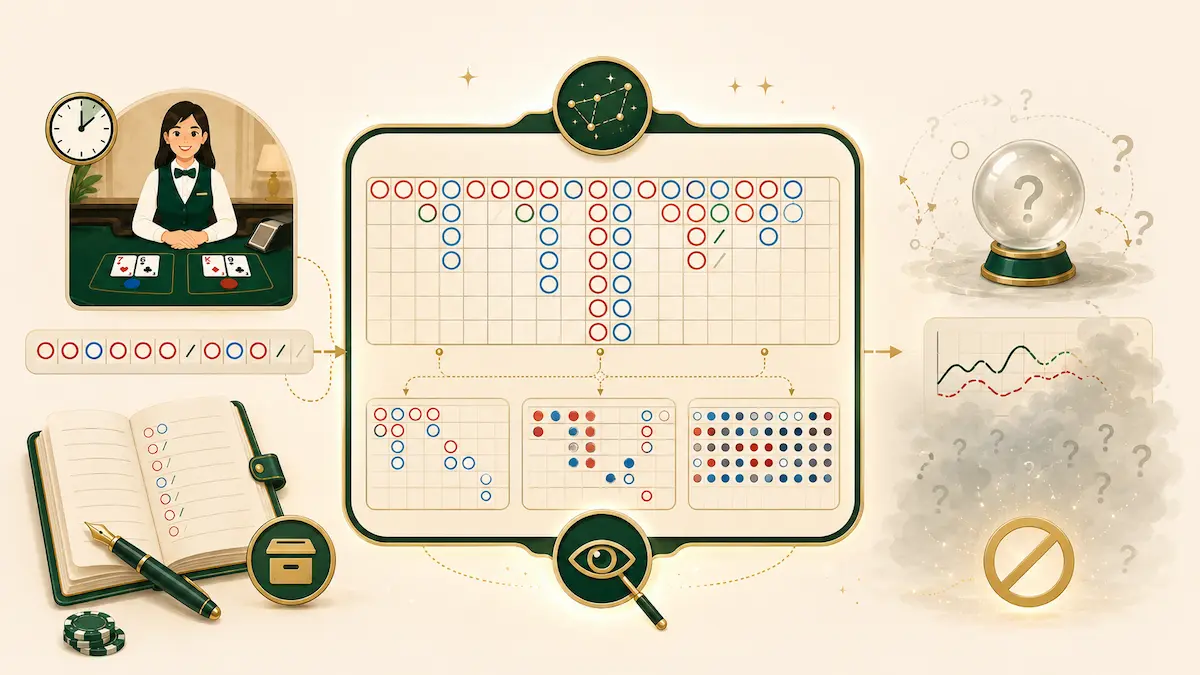


The four roads, decoded
The scoreboard isn’t one display — it’s a family of four, each “deriving” deeper patterns from the last. Here’s the whole system:
| Road | What it tracks | How players read it |
|---|---|---|
| Big Road | Every result: red = Banker, blue = Player, ties as green slashes | Columns grow during streaks; “dragons” are long streaks |
| Big Eye Boy | Whether the Big Road is forming “orderly” patterns | Red = repetitive shoe, blue = choppy shoe |
| Small Road | Same idea, skipping one column back | A second opinion on “orderliness” |
| Cockroach Pig | Same idea, skipping two columns back | A third opinion, even more abstract |
Notice something? The last three roads don’t track results at all — they track the shape of the chart of the results. It’s pattern-reading about pattern-reading. Genuinely ingenious. Genuinely useless for prediction.
Why the casino paints it for you
Casinos don’t install those screens out of generosity. The roads do two jobs: they make players feel informed and in control (confident players bet more), and they slow nobody down — you study the board between hands, not instead of them. If pattern-reading actually beat the game, the screens would vanish overnight. They’re the cheapest marketing in the building.
The math behind the mirage
Streaks feel meaningful because randomness is streakier than human intuition expects. In any 70-hand shoe, a run of four or more identical results is more likely than not — so every session “confirms” the pattern-reader’s faith. That’s the gambler’s fallacy doing its work: we remember the dragon we rode and forget the three that bucked us. The probabilities never moved. Read why betting systems can’t beat baccarat — roads are the same error wearing a prettier uniform.
What the roads are actually good for
- Pace. Following the board gives your session rhythm and keeps you from impulse-betting every hand.
- The social game. At a live Asian table, reading the roads is half the culture — fluency in them is fluency at the table.
- A record. They’re an honest log of the shoe — useful for tracking your session, useless for forecasting it.
- A warning light. The moment you catch yourself raising a bet because of a road, you’ve crossed from culture into superstition. That’s the line.
Quick questions
What is a “dragon” in baccarat?
A long unbroken streak of one outcome on the Big Road — six or more is usually called a dragon. Spectacular to see, statistically ordinary, and predictive of nothing.
Do professional players use the roads?
Professionals in baccarat manage money; they don’t forecast outcomes. The closest thing to a real edge ever found — edge sorting — came from card-back flaws, not scoreboards, and casinos closed that door years ago.
Is it rude to ignore the roads at a live table?
Not at all. Nobody minds. But knowing how to read them makes the table more fun — treat them as the game’s commentary track, not its script.