

A single hand of baccarat is over in well under a minute, and once you have watched one play out card by card, the whole game clicks into place. This page follows one round from the first card to the payout — exactly as it happens at a live table or in an online game — so you can see precisely when a third card appears, who wins, and why you never have to lift a finger.
Before the cards: place your bet
Every round begins with you backing one of three outcomes — the Banker hand, the Player hand, or a Tie — before a single card is exposed. If you are still deciding which is the smart wager, the short answer is the Banker, and we explain the full reasoning in our guide to the baccarat house edge. Once your chips are down, your job is done. Everything that follows runs on autopilot.
The whole round in five steps
Here is the entire sequence at a glance — we break down each step below:
- 1Place your bet.On Banker, Player, or Tie, before any cards are dealt.
- 2The opening deal.Two cards to each hand, from the shoe.
- 3Check for a natural.An 8 or 9 on the first two cards ends the round instantly.
- 4Apply the drawing rules.A third card may be dealt to either hand — by fixed rule, never choice.
- 5Compare and pay.The hand closer to 9 wins.
Step 1 — The opening deal: four cards
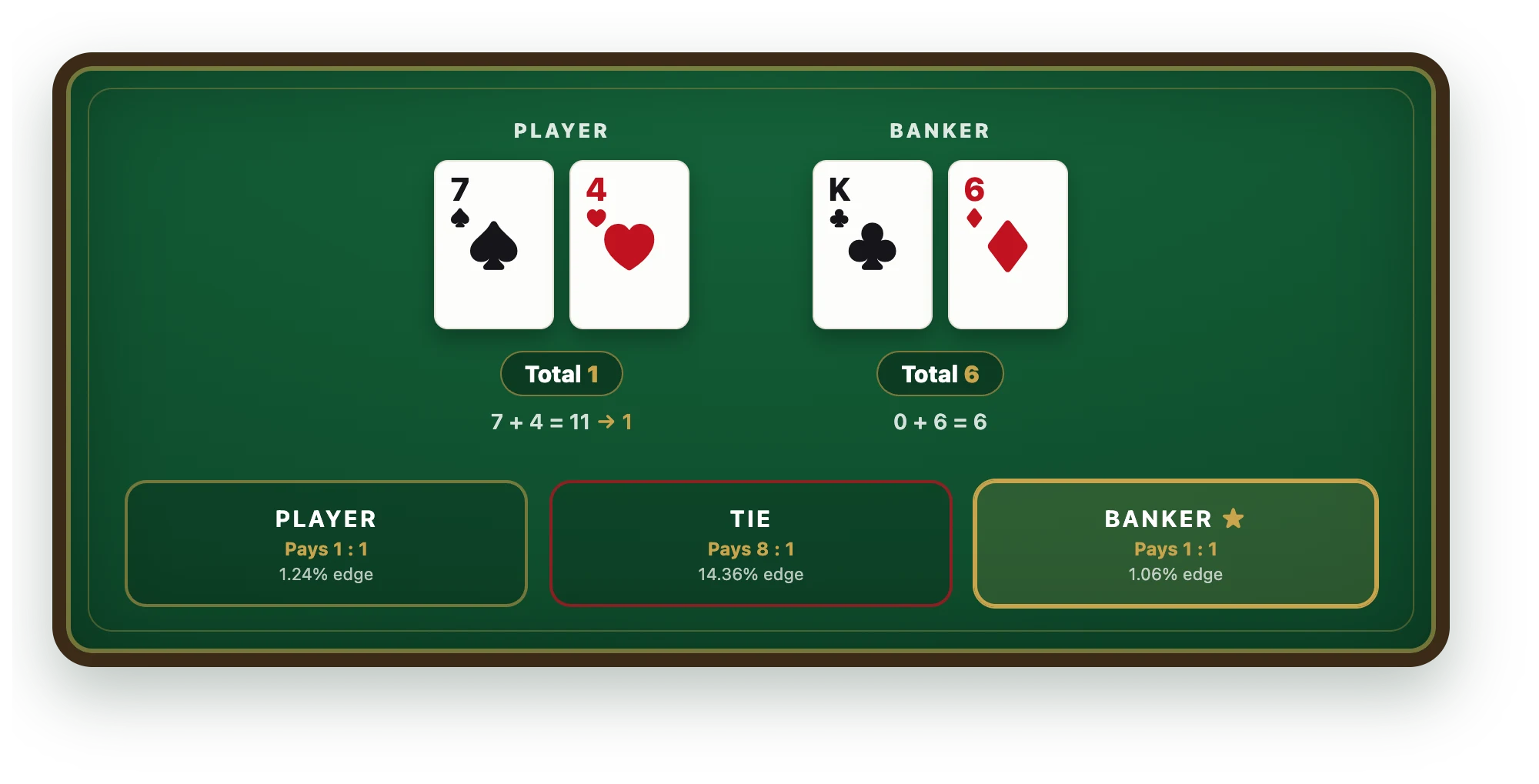
The dealer deals two cards to each hand, alternating: Player, Banker, Player, Banker. The cards come from the shoe, a box holding six or eight shuffled decks. Each card is scored on its point value — aces are 1, two through nine are face value, and tens and all face cards are 0. If you want the full logic of how two cards become a single total, see how baccarat hands are scored.
Step 2 — Check for a natural
As soon as the four cards are down, the dealer looks for a natural: a two-card total of 8 or 9. This is the game’s instant-win condition.
- If either hand shows a natural 9, it wins (a natural 9 beats a natural 8).
- If either hand shows a natural 8 and the other does not show 9, the 8 wins.
- If both hands are naturals of the same value, the round is a Tie.
When a natural appears, the round is over right there — no third card is ever drawn. Roughly one hand in six ends this way, so naturals are common enough that you will see them constantly.
Step 3 — The Player hand acts first
If neither hand has a natural, the Player hand resolves first under one simple rule:
| Player’s two-card total | Action |
|---|---|
| 0, 1, 2, 3, 4, 5 | Draws a third card |
| 6 or 7 | Stands (no third card) |
| 8 or 9 | Natural — round already ended at Step 2 |
That is the entire Player rule. There is nothing to memorise as a bettor — the dealer applies it automatically.
Step 4 — The Banker hand responds
The Banker hand acts last, and its rule is the only intricate part of baccarat. If the Player stood, the Banker simply draws on 0–5 and stands on 6–7. If the Player did draw a third card, whether the Banker draws depends on both the Banker’s total and the exact value of the Player’s third card. This is why the Banker hand wins slightly more often — it gets to react. The complete decision table lives on our baccarat rules and third-card chart page.
Step 5 — Compare totals and pay out
Whatever cards have landed, the hand closer to 9 wins. Winning Player bets pay even money. Winning Banker bets also pay even money but the casino keeps a 5% commission, because the Banker’s edge has to be clawed back somehow. A Tie bet pays 8:1 only when the two hands finish level — and as the maths on our Banker vs Player page shows, that is far rarer than the payout suggests.
A full round, card by card
What “playing” actually involves
Now you can see why experienced players say baccarat has no learning curve at the table. Your entire involvement is two decisions made before the cards: which bet, and how much. Everything after that is mechanical. The skill — such as it is — lies in choosing the lowest-edge bet and managing your money, which is exactly what our honest guide to baccarat strategy and our bankroll guide cover.
Where to go next
You now know the shape of a round. To go deeper, study the exact drawing rules, learn how totals are scored, or return to the how-to-play overview. When you want the numbers, the odds and probabilities section has them all.
How many cards are in a round of baccarat?
Between four and six. Each hand always gets two cards, and each may receive one additional card under the fixed drawing rules — never more than three per hand.
Who decides whether a third card is dealt?
Nobody. Fixed rules decide it based on the hand totals and, for the Banker, the value of the Player’s third card. The dealer or software simply applies the chart.
Can the Player or Banker draw two extra cards?
No. Each hand receives a maximum of one third card, so a hand never holds more than three cards.
What happens if both hands tie?
Bets on Banker and Player push (your stake is returned), and only a Tie bet wins, paying 8:1 at most tables.
Does it matter if I play live or online?
No. The sequence and rules are identical. Online games use a certified random number generator or a live-streamed dealer, but the drawing logic is exactly the same.